This is a poem written by my very talented friend and fellow 'do-gooder' (her words!), Sarah Clancy, in response to my blogging on Haiti.
The trouble with travel
Alice never quite adjusted
to just shiny glass reflections
after,
worse her mirror malfunctioned
showing someone she wasn't
anymore
food she'd liked before was tastless
she found her own culture somehow
lacking
most concerning though, returning
was an option she explored in
depth
she found it oddly changed there
too.

Friday, May 7, 2010


Wednesday, May 5, 2010
Port au Prince
Life and death in ravaged Port au Prince
Life goes on. People endure. The most shocking aspect of refugee camps in Port au Prince is that one simple fact.
For the survivors of the earthquake, the most difficult thing is continuing. Death is all around them – they have lost family, friends, communities, homes, everything. But life continues in the camps.

The most mundane aspects of life are here: women wash clothes in small basins of water distributed from tankers; they cook whatever food they have outside their tents at small camp fires; they hang clothing to dry on their tarps.
Mostly, they sit. They have no work, no fun, no prospects. They talk, but there is nothing to talk about except when the next water delivery will come. The men have spent weeks walking the city’s rubble-strewn streets seeking work. There is none.
Children come running at the sight of us entering the camps – we are some rare entertainment. They point at our white skin, my blonde hair, our t-shirts. They want their photo taken, and they want to see the photo. They wave and play peekaboo as they follow us around our poking, prodding visit to their homes.
Leadership
In Camp Citron, one of the camps set up by a community within days of their homes being destroyed, we are welcomed by a group of young men, who turn out to be the camp’s committee.
These young men, with an average age of about 20, are incredible. They speak French, some speak English; they are an intelligent bunch. They are running the camps in which thousands live, on their own. They liaise with Haven and other NGOs.
One of them answers all my questions, then politely asks why I am here and what I am doing to help. It’s a good question. I say we are here to make sure people in Ireland know the situation so they can continue to support organizations like Haven. He’s happy with that.

Another young man, Anderson (pictured) , guides us around the camp. His life has been lived according to all the advice we give developing countries.
He has gone to school, worked hard, learned English, French and Spanish as well as his native Creole. His French is much better than mine, and I have a degree in it. After answering my questions about the camp patiently, he tells me he’d like to go to college. “Do you know how I could get a scholarship? I will go anywhere, anywhere in the world? I would like to be an engineer.”
Port au Prince’s university is gone, destroyed in the earthquake. Anderson’s chances are limited purely by his place and time of birth.
I have no answer for him. Later I find out he had the same conversation with everyone else in the group. His intelligence, his work ethic and his belief, without foundation it seems, that he can do this, are the hardest things of all to see in this place of no hope.
I think of young men and women at home who are handed education and opportunities like a bag of sweets and discard the wrappings on the ground after them, and I am suddenly, impotently angry. I advise Anderson to try and get a job translating for an NGO. It is the only thing I can think of.
Grief
In the camp, I meet Viagela Mathieu (pictured below with her husband). A slim, dignified lady in an green shift dress far too big for her, she is the oldest person I have seen in Haiti. The interpreter tells me Madame is 69-years-old. She lost two children in the earthquake.
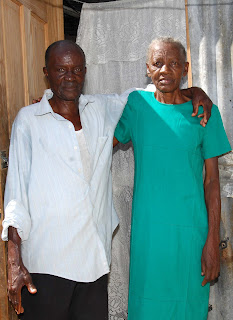
She lives in the camp with her remaining five children. What strikes me about Viagela is her stillness. She answers my questions almost silently, with imperceptible nods and a blank expression. It’s as if she believes that speaking loudly or moving too much will cause another ‘tremblement’ and destroy all of their lives again. Her husband smiles for the camera and puts his arm around her and all the while she stares straight ahead. I pat her gently on the arm as I leave, to thank her for her help. She doesn’t react.
Camp Toto
Camp Toto was found by Haven workers just two weeks ago. This rocky hillside across a rocky ravine from its residents’ former homes hosts 2000 people, while four neighbouring camps are home to 8000 more.
When Haven workers reached the camp, which is located off the beaten track in an area blocked off by rubble, they were aghast to learn they were the first NGO to help. There is a painted wall outside with the phone numbers of the camp’s committee members – everyone has a mobile phone, thanks to Denis O’Brien’s Digicel – and the words ‘We need help. We love all’.

The Government plans to move 10,000 more people into an area adjacent which it has flattened with bulldozers – those who will move in here have just been cleared from the grounds of St Louis Gonzaga school, which needs to reopen. Some of their tents have been destroyed; they were given just hours’ notice of the move.
A camp committee, set up by residents including Falayraud Edzei, has ensured a tidy layout and has helped Haven start building latrines and sanitation facilities. Edzei had an import/export business; he’s educated, with good French, and is helpful and energetic. He lost everything in the quake.
Louie Camen was pregnant before the quake, and she’s due in May. She’s 19 years old, and her husband is in the camp with her. This will be her first baby. A slim girl with a shy smile and cropped hair, as she speaks to me, abashed, through a forceful interpreter, one hand cups her belly protectively while the other grips the umbrella sheltering her from the merciless heat of the early afternoon. Her husband is good, she says, but she is afraid to have her baby here.
As we scramble further up the hill, children pointing and laughing at our hands-and-knees ascent between tarp shacks up the stepped rocky terrain, I am drawn to another tent by Mr Edzei.
New life
A woman ambles out to meet us, holding her abdomen in pain. She has the same glazed look I met in Camp Citron, as if any expression will cause all her pain and grief to escape.
She is in her early twenties, and has just given birth, they tell me. Her baby was born on Saturday – just four days ago. Neither of them has seen a doctor, and she is in a lot of pain, she says.
We go into the tent. Outside the temperature is about 48 degrees, but inside this plastic oven it is hotter, over 50, I think. The baby lies on his back on the family’s makeshift bed – he is wearing a stained babygro and lying on a sheet. There are no nappies, and the stinking tent is scattered with stained clothing. I can hear the baby’s laboured breathing from the doorway.

The baby hasn’t been named yet – his father, Bertoni, will name him. Bertoni has no work and the couple has two other children. Both parents lost their families in the earthquake, and this girl gave birth alone. I have never seen anyone look so desolate. She lost her parents in the tremblemenet,
I think for a moment of all the babies born in Cork on the same day, and how they will be home from CUH by now, surrounded by balloons and flowers and showered with love. I have a dollar in my pocket, somehow, as we were warned not to carry cash. We’re not supposed to, but I give it to her anyway, ‘pour la bébé’. It’s not much, even here.
I travelled to Haiti with the Haven Partnership. Thanks to everyone who helped with fundraising.
To donate, visit www.havenpartnership.com.
Haven works to build homes in Haiti as well as providing emergency water and sanitation assistance in Port au Prince.
Photos by Pascal Ungerer.
Life goes on. People endure. The most shocking aspect of refugee camps in Port au Prince is that one simple fact.
For the survivors of the earthquake, the most difficult thing is continuing. Death is all around them – they have lost family, friends, communities, homes, everything. But life continues in the camps.

The most mundane aspects of life are here: women wash clothes in small basins of water distributed from tankers; they cook whatever food they have outside their tents at small camp fires; they hang clothing to dry on their tarps.
Mostly, they sit. They have no work, no fun, no prospects. They talk, but there is nothing to talk about except when the next water delivery will come. The men have spent weeks walking the city’s rubble-strewn streets seeking work. There is none.
Children come running at the sight of us entering the camps – we are some rare entertainment. They point at our white skin, my blonde hair, our t-shirts. They want their photo taken, and they want to see the photo. They wave and play peekaboo as they follow us around our poking, prodding visit to their homes.
Leadership
In Camp Citron, one of the camps set up by a community within days of their homes being destroyed, we are welcomed by a group of young men, who turn out to be the camp’s committee.
These young men, with an average age of about 20, are incredible. They speak French, some speak English; they are an intelligent bunch. They are running the camps in which thousands live, on their own. They liaise with Haven and other NGOs.
One of them answers all my questions, then politely asks why I am here and what I am doing to help. It’s a good question. I say we are here to make sure people in Ireland know the situation so they can continue to support organizations like Haven. He’s happy with that.

Another young man, Anderson (pictured) , guides us around the camp. His life has been lived according to all the advice we give developing countries.
He has gone to school, worked hard, learned English, French and Spanish as well as his native Creole. His French is much better than mine, and I have a degree in it. After answering my questions about the camp patiently, he tells me he’d like to go to college. “Do you know how I could get a scholarship? I will go anywhere, anywhere in the world? I would like to be an engineer.”
Port au Prince’s university is gone, destroyed in the earthquake. Anderson’s chances are limited purely by his place and time of birth.
I have no answer for him. Later I find out he had the same conversation with everyone else in the group. His intelligence, his work ethic and his belief, without foundation it seems, that he can do this, are the hardest things of all to see in this place of no hope.
I think of young men and women at home who are handed education and opportunities like a bag of sweets and discard the wrappings on the ground after them, and I am suddenly, impotently angry. I advise Anderson to try and get a job translating for an NGO. It is the only thing I can think of.
Grief
In the camp, I meet Viagela Mathieu (pictured below with her husband). A slim, dignified lady in an green shift dress far too big for her, she is the oldest person I have seen in Haiti. The interpreter tells me Madame is 69-years-old. She lost two children in the earthquake.

She lives in the camp with her remaining five children. What strikes me about Viagela is her stillness. She answers my questions almost silently, with imperceptible nods and a blank expression. It’s as if she believes that speaking loudly or moving too much will cause another ‘tremblement’ and destroy all of their lives again. Her husband smiles for the camera and puts his arm around her and all the while she stares straight ahead. I pat her gently on the arm as I leave, to thank her for her help. She doesn’t react.
Camp Toto
Camp Toto was found by Haven workers just two weeks ago. This rocky hillside across a rocky ravine from its residents’ former homes hosts 2000 people, while four neighbouring camps are home to 8000 more.
When Haven workers reached the camp, which is located off the beaten track in an area blocked off by rubble, they were aghast to learn they were the first NGO to help. There is a painted wall outside with the phone numbers of the camp’s committee members – everyone has a mobile phone, thanks to Denis O’Brien’s Digicel – and the words ‘We need help. We love all’.

The Government plans to move 10,000 more people into an area adjacent which it has flattened with bulldozers – those who will move in here have just been cleared from the grounds of St Louis Gonzaga school, which needs to reopen. Some of their tents have been destroyed; they were given just hours’ notice of the move.
A camp committee, set up by residents including Falayraud Edzei, has ensured a tidy layout and has helped Haven start building latrines and sanitation facilities. Edzei had an import/export business; he’s educated, with good French, and is helpful and energetic. He lost everything in the quake.
Louie Camen was pregnant before the quake, and she’s due in May. She’s 19 years old, and her husband is in the camp with her. This will be her first baby. A slim girl with a shy smile and cropped hair, as she speaks to me, abashed, through a forceful interpreter, one hand cups her belly protectively while the other grips the umbrella sheltering her from the merciless heat of the early afternoon. Her husband is good, she says, but she is afraid to have her baby here.
As we scramble further up the hill, children pointing and laughing at our hands-and-knees ascent between tarp shacks up the stepped rocky terrain, I am drawn to another tent by Mr Edzei.
New life
A woman ambles out to meet us, holding her abdomen in pain. She has the same glazed look I met in Camp Citron, as if any expression will cause all her pain and grief to escape.
She is in her early twenties, and has just given birth, they tell me. Her baby was born on Saturday – just four days ago. Neither of them has seen a doctor, and she is in a lot of pain, she says.
We go into the tent. Outside the temperature is about 48 degrees, but inside this plastic oven it is hotter, over 50, I think. The baby lies on his back on the family’s makeshift bed – he is wearing a stained babygro and lying on a sheet. There are no nappies, and the stinking tent is scattered with stained clothing. I can hear the baby’s laboured breathing from the doorway.

The baby hasn’t been named yet – his father, Bertoni, will name him. Bertoni has no work and the couple has two other children. Both parents lost their families in the earthquake, and this girl gave birth alone. I have never seen anyone look so desolate. She lost her parents in the tremblemenet,
I think for a moment of all the babies born in Cork on the same day, and how they will be home from CUH by now, surrounded by balloons and flowers and showered with love. I have a dollar in my pocket, somehow, as we were warned not to carry cash. We’re not supposed to, but I give it to her anyway, ‘pour la bébé’. It’s not much, even here.
I travelled to Haiti with the Haven Partnership. Thanks to everyone who helped with fundraising.
To donate, visit www.havenpartnership.com.
Haven works to build homes in Haiti as well as providing emergency water and sanitation assistance in Port au Prince.
Photos by Pascal Ungerer.
Thursday, April 29, 2010
Haiti
It’s the dirt that hits you first. Poverty is dirty. Poverty means rusted tin cans, broken glass, polystyrene takeaway trays and plastic bottles. They are everywhere.
Ripped, dusty shreds of black plastic salute the onlooker, whipping in the wind from gnarled bushes. Rocks litter the landscape, and dust flies up before the wheels of the four-by-four.
Galvanised metal and dirty plastic sheeting blot the vista, until you look closer and realize the brightly coloured dots beside them are people, and the rubbish is their homes. Goats can be seen tottering precariously on cliffsides, wandering across roads and foraging in deforested, dusty expanses for rubbish and stray vegetation.
Travelling from Port au Prince to Haven’s Build It Week building site in Gonaives, Northern Haiti (about 170km, a six-hour journey by bus), the landscape changes from filthy, dusty urban, to rural poor, and back. The road is rough in places and almost non-existent in others. As we travel it is Sunday evening, and there are people, beautifully dressed in their best, going to and from church.
In one village, we pass a wedding; a woman’s exquisite white dress among the churchgoing crowd draws my eye from the bus, and as we pass the church I see her groom waiting anxiously at the door, with a coterie of handsome men beside him.
The convoy of Haven volunteers – six coaches brought in from the Dominican Republic and a number of security jeeps – gets wide eyed stares all the way. Children wave and shout, while adults look weary, resigned to more interference, positive though it may be.
HAVEN
Before the earthquake of 12 January, Haven had committed to building 1000 houses in Haiti in the next three years.
After the earthquake, Haven’s Leslie Buckley said the charity would build 10,000 homes in four years.
The process had begun with last year’s Build It Week, when 41 houses were built in Ouaniminthe, near the border with the Dominican Republic. Since then, 150 houses have been built and there are 50 more to go.
This year volunteers will build in Gonaives, which was largely destroyed by hurricanes, floods and mudslides in 2004 and 2008. Homes were swept away and over 10,000 people were evacuated for Hurricane Ike alone, while hundreds were killed.
SHELTER
Kosanius Phabiua lost three children and her home in Hurricane Ike in 2008. They were swept away before her eyes.
Now, she lives with her two remaining daughters and her husband, under a tarpaulin, miles from Gonaives, in an area called Mapoue.
They have lived in this shelter – a frayed, dirty USAID tarpaulin, supported by a rusted metal bed frame, a length of rope, and some rocks – for over two years.
She’s terrified of remaining here for another rainy season, afraid to lose the little she has left. Her elderly father lives under a similar tarpaulin beside them.
Her elder daughter, Rosnika, is disabled.
Like most of the children we’ve encountered in Haiti, she jumped excitedly up and down on our approach, waving with her one good arm and squealing. Rosnika’s condition means, our Haitian interpreter told us, “she’s dumb”.
We met her just minutes before, 100m away, a couple of hundred primary school kids came out to play at lunchtime. Rosnika doesn’t go to school, because there’s no school for her.
Perfectly turned out children in white and blue uniforms, the girls with neatly braided, beribboned hair, waved us off from inside the school gates.
SLUMS
Nearer to Gonaives, in a slum area called Raboteau, a densely packed array of shacks greets us. The stench is overwhelming at first, but so is the welcome from the area’s brightly dressed children, who come running out to meet us, curiously studying everything from our shoes to our unusually coloured hair.
Raboteau was decimated by hurricanes and mudslides in 2004 and 2008, and over 100,000 people live there in desperate conditions. There is no sanitation, with pigs, chickens, broken glass, human excrement and playing children all sharing the same patch of ground.
Pamela Vincent, who’s 29-years-old and about six months pregnant, lives in a one-roomed shelter with her husband, Joseph, a taxi driver. He earns about $3 per day, not enough, she tells us sadly, for them to move out of the slum.
Pamela apologises through the interpreter because she doesn’t have enough chairs for us. Despite the conditions she’s living in, her dignity is overwhelming.
In another life, she’d have been an interior designer, or perhaps a fashion buyer. She is wearing a gorgeous, spotless, lace dress. A beautiful embroidered curtain hangs over the doorway to the shack, and inside, just visible in the gloom, is a hanging wreath of purple fabric flowers.
Nearby we can see a dead pig in the only visible waterway, which is murky green. Barefoot children are scampering around us, posing for the cameras and grinning at us.
HOPE
Both women welcomed us to what currently passes for their homes; they will be beneficiaries of the houses Haven is building. They’ve participated in Haven’s survey which allocates the homes on a points basis; number of dependents, income levels and history all contribute to points.
Both tell us they are looking forward to their new homes. Pamela nods shyly when asked if she has plans to decorate the new house outside Gonaives; she is already imagining it.
As we leave Raboteau, there’s a minor scene when a woman who won’t be receiving a house accosts Farah, Haven’s community development worker. She’s angry and upset.
Not everyone can have one of the new homes; there are simply not enough to go around, not this time. 144 houses are planned for this phase of the development, while volunteers will build 60 of those this week, along with a playground and community centre.
To find out more about Haven’s work in Haiti or to donate, see www.havenpartnership.com.
Ripped, dusty shreds of black plastic salute the onlooker, whipping in the wind from gnarled bushes. Rocks litter the landscape, and dust flies up before the wheels of the four-by-four.
Galvanised metal and dirty plastic sheeting blot the vista, until you look closer and realize the brightly coloured dots beside them are people, and the rubbish is their homes. Goats can be seen tottering precariously on cliffsides, wandering across roads and foraging in deforested, dusty expanses for rubbish and stray vegetation.
Travelling from Port au Prince to Haven’s Build It Week building site in Gonaives, Northern Haiti (about 170km, a six-hour journey by bus), the landscape changes from filthy, dusty urban, to rural poor, and back. The road is rough in places and almost non-existent in others. As we travel it is Sunday evening, and there are people, beautifully dressed in their best, going to and from church.
In one village, we pass a wedding; a woman’s exquisite white dress among the churchgoing crowd draws my eye from the bus, and as we pass the church I see her groom waiting anxiously at the door, with a coterie of handsome men beside him.
The convoy of Haven volunteers – six coaches brought in from the Dominican Republic and a number of security jeeps – gets wide eyed stares all the way. Children wave and shout, while adults look weary, resigned to more interference, positive though it may be.
HAVEN
Before the earthquake of 12 January, Haven had committed to building 1000 houses in Haiti in the next three years.
After the earthquake, Haven’s Leslie Buckley said the charity would build 10,000 homes in four years.
The process had begun with last year’s Build It Week, when 41 houses were built in Ouaniminthe, near the border with the Dominican Republic. Since then, 150 houses have been built and there are 50 more to go.
This year volunteers will build in Gonaives, which was largely destroyed by hurricanes, floods and mudslides in 2004 and 2008. Homes were swept away and over 10,000 people were evacuated for Hurricane Ike alone, while hundreds were killed.
SHELTER
Kosanius Phabiua lost three children and her home in Hurricane Ike in 2008. They were swept away before her eyes.
Now, she lives with her two remaining daughters and her husband, under a tarpaulin, miles from Gonaives, in an area called Mapoue.
They have lived in this shelter – a frayed, dirty USAID tarpaulin, supported by a rusted metal bed frame, a length of rope, and some rocks – for over two years.
She’s terrified of remaining here for another rainy season, afraid to lose the little she has left. Her elderly father lives under a similar tarpaulin beside them.
Her elder daughter, Rosnika, is disabled.
Like most of the children we’ve encountered in Haiti, she jumped excitedly up and down on our approach, waving with her one good arm and squealing. Rosnika’s condition means, our Haitian interpreter told us, “she’s dumb”.
We met her just minutes before, 100m away, a couple of hundred primary school kids came out to play at lunchtime. Rosnika doesn’t go to school, because there’s no school for her.
Perfectly turned out children in white and blue uniforms, the girls with neatly braided, beribboned hair, waved us off from inside the school gates.
SLUMS
Nearer to Gonaives, in a slum area called Raboteau, a densely packed array of shacks greets us. The stench is overwhelming at first, but so is the welcome from the area’s brightly dressed children, who come running out to meet us, curiously studying everything from our shoes to our unusually coloured hair.
Raboteau was decimated by hurricanes and mudslides in 2004 and 2008, and over 100,000 people live there in desperate conditions. There is no sanitation, with pigs, chickens, broken glass, human excrement and playing children all sharing the same patch of ground.
Pamela Vincent, who’s 29-years-old and about six months pregnant, lives in a one-roomed shelter with her husband, Joseph, a taxi driver. He earns about $3 per day, not enough, she tells us sadly, for them to move out of the slum.
Pamela apologises through the interpreter because she doesn’t have enough chairs for us. Despite the conditions she’s living in, her dignity is overwhelming.
In another life, she’d have been an interior designer, or perhaps a fashion buyer. She is wearing a gorgeous, spotless, lace dress. A beautiful embroidered curtain hangs over the doorway to the shack, and inside, just visible in the gloom, is a hanging wreath of purple fabric flowers.
Nearby we can see a dead pig in the only visible waterway, which is murky green. Barefoot children are scampering around us, posing for the cameras and grinning at us.
HOPE
Both women welcomed us to what currently passes for their homes; they will be beneficiaries of the houses Haven is building. They’ve participated in Haven’s survey which allocates the homes on a points basis; number of dependents, income levels and history all contribute to points.
Both tell us they are looking forward to their new homes. Pamela nods shyly when asked if she has plans to decorate the new house outside Gonaives; she is already imagining it.
As we leave Raboteau, there’s a minor scene when a woman who won’t be receiving a house accosts Farah, Haven’s community development worker. She’s angry and upset.
Not everyone can have one of the new homes; there are simply not enough to go around, not this time. 144 houses are planned for this phase of the development, while volunteers will build 60 of those this week, along with a playground and community centre.
To find out more about Haven’s work in Haiti or to donate, see www.havenpartnership.com.
Subscribe to:
Posts (Atom)